

Find a car
Step 1: Browse For Used Vehicles Online
- Vehicle listing sites such as Autotrader.
- Online classifieds
- National classifieds such as Craigslist and OfferUp.
- Local classifieds such as KSL Cars.
- Social media listings.
- Auction websites such as Cars and Bids and Hemmings.
While these platforms help you find used cars near you, all of them lack transactional capabilities. Because they leave you to your own devices when it comes down to closing the deal, we call them “meetingplaces”.
We’re the only fully self-service tech-enabled solution for every stage of the deal.
We have nothing against other listing sites. We’re happy for you if you find your car on one of them. But we still want you to have the transactional security and convenience that our users enjoy.
That’s why DealNow was created. It allows you to start a deal on any site, and close the transactions anytime.
Invite the seller to DealNow and fast-track your transaction.

Should I buy from a private seller?
Step 2: Negotiate the Price
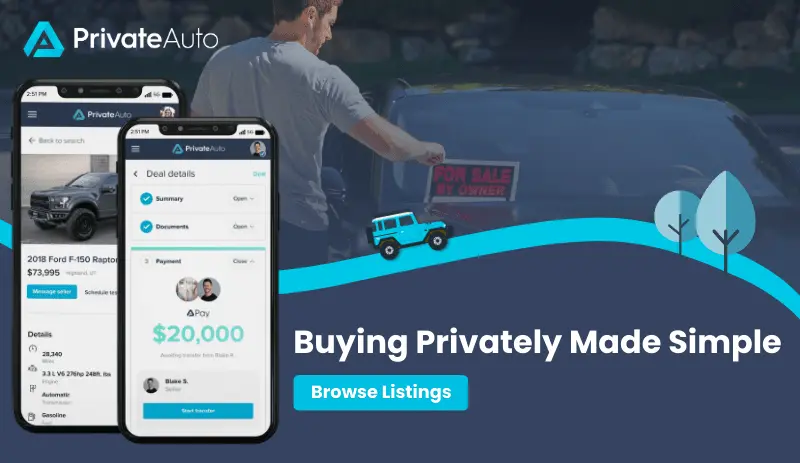
On other sites, you’d have to message the seller and have an awkward conversation. PrivateAuto lets you make an offer with the click of a button. The seller can then accept, reject, or counteroffer.
Step 3: Car Research
We have partnered with AutoCheck to provide vehicle history reports on premium listings. AutoCheck gets its data from the following sources:
- Collision repair shops.
- Service records from maintenance facilities.
- OEM manufacturers.
- State Departments of Motor Vehicles (DMVs).
- Import and export companies.
- Insurance companies.
- Salvage auctions.
- Car dealerships and extended warranty companies.
- Auto auctions.
- Vehicle inspection and state inspection stations.
- Rental and fleet companies.
Running an AutoCheck on a vehicle uncovers valuable insights into the car’s background, including things like:
- Regular maintenance (or lack thereof).
- Stolen cars.
- Major repairs.
- Open recalls.
- City and state of previous registration, number of owners.
- Accidents and damage reports, stolen vehicles.
- Rental, taxi, lease, or government use.
- Emissions records.
- Odometer rollback.
- Title history: salvage titles, junk titles, flood damage, hail damage, storm damage, fire damage, and more.
- Lien information, ownership transfers.
- Manufacturer buybacks or lemon titles.
- Collision repair history.
- Structural or frame damage.
- Service, repair, and maintenance performed.
- Total loss and reason for the loss.
- And lots more…
Take the car for a test drive
Step 4: Go for a Test Drive
We keep your info secure. All communication happens through our secure messaging system. The in-app scheduler makes it easy to schedule the meetup—just select from the seller’s available times and show up at their designated location.
Do car research
Step 5: Vehicle Inspection
Order a pre-purchase inspection in your PrivateAuto service hub, and a Lemon Squad inspector will come to your location.
Here are some of the things a good inspection will cover:
- Fluids: check all fluid levels, including engine oil, transmission fluid, brake fluid, power steering fluid, and coolant. Look for leaks and make sure the fluids look clean and at proper levels.
- Body: check for obvious damage, body panel alignment, uneven gaps, mismatched paint, and signs of damage repair. Look closely for any indications of collision repair. Check for rust underneath and around various body panels. Check headlights, brake lights, and other lights.
- Undercarriage: inspect the car for leaks, rust, and damage. Look at brake lines, exhaust, and suspension components.
- Tires: examine tire treads and make sure there is sufficient tread depth. Also look for any cracks, bulges, or other tire damage. Check the spare as well.
- Maintenance records: review the vehicle history report and check maintenance logs to understand repair and ownership history.
- Interior: ensure all controls, electronics, air conditioning, and heating work properly. Look for any warning lights on the dash when the car is started. Check for water damage, stains, or tears inside.
- Test drive: drive the car under different conditions to test acceleration, braking, steering, and transmission, and to feel and listen for any mechanical issues.
Handle paperwork
Step 6: Sign the Connecticut Bill of Sale
Here are the necessary elements included in a bill of sale:
- Your full name and signature.
- The make, model, and year of the car.
- Date of the transaction.
- Price of the car.
- The other party’s full name and signature.
- A warranty disclaimer stating the car is being sold as-is.
PrivateAuto provides an official Connecticut bill of sale as part of our standard in-app transaction process. At the appropriate stage of the transaction workflow, the buyer and seller will be asked to sign the Connecticut bill of sale electronically in the PrivateAuto app.
Pay the seller
Step 7: Pay for the Car
You can send unlimited funds to the seller with no transfer fees. Weekends, holidays, or in the middle of the night—anytime. The seller will receive the money immediately. It’s convenient, secure, and most importantly, easy to use. Its instantaneous nature provides escrow-like safeguards for you to control the deal.
If you are not in a place where you can pay cash for your next car, you can apply for a used car loan directly through the PrivateAuto app. When your application is approved, your profile will show that you have verified funds, which will set you apart from other buyers.
Our lending partner will pay the seller in full when you close the deal and send payment. You will make monthly car payments to the lender. It’s that simple.
Want to know how much your payments will be? Our car loan calculator will tell you.
Step 8: Sign the Official Title
Both parties need to fill out the vehicle title certificate thoroughly. The following info is required:
- Names
- Addresses
- Signatures
- Vehicle identification number (VIN)
- Damage disclosure statement
- An odometer disclosure statement (in many states)
Odometer Disclosure
You can always complete the Federal Odometer Disclosure Statement so your bases are covered.
Inspect the odometer to verify that the seller’s entry is correct. Keep in mind that sellers who tamper with a car’s odometer to obtain a false reading can face serious consequences.
The PrivateAuto app has a field for the odometer reading so that both the buyer and the seller can check the mileage before moving forward.
VIN Check
The PrivateAuto app has a field for the VIN, where both the buyer and seller can check it for accuracy. This helps to eliminate any errors (or the rare case of outright seller fraud).
Insure the car
Step 9: Get Auto Insurance
The PrivateAuto app makes it easy to compare rates and get car insurance.
Transfer ownership
Register the car
Get a new license plate
Step 10: Finalize with Connecticut DMV
They will require the following:
- The vehicle title signed by the previous vehicle owner.
- Bill of sale (proof of ownership)
- Completed Registration And Title Application
- Proof of valid vehicle insurance.
- Payment for the title transfer fee: $25.
- Payment for the passenger vehicle registration fee: $120.
- Payment for Connecticut car sales tax (based on your car’s purchase price).
- Payment for Connecticut license plate: $8.
- Potentially other taxes and fees, depending on your city and county of residence.
- Valid driver’s license.
Connecticut License Plates
Connecticut’s standard license plate fee is $8. A vanity plate costs an additional $94.
Connecticut Emissions Testing
- Requirements: all Connecticut cars are required to undergo emissions testing every two years. This includes both passenger vehicles and commercial vehicles, as well as hybrids and electric cars.
- Schedule: based on the last digit of your license plate number. You can find specific testing deadlines on the Connecticut DMV website.
- Locations: there are emissions testing locations throughout the state, and you can find the one nearest to you on the DMV website as well. Some locations are appointment-only, so be sure to check before you go.
- Fees: the fee for emissions testing in Connecticut is $20 for most vehicles, but some larger commercial vehicles may be subject to higher fees.
If your vehicle fails the emissions test, you will be required to have it repaired and retested before you can renew your registration.
If you are a new resident of Connecticut, you must pass an emissions test before registering your vehicle with the Connecticut DMV.
Here are the exempted vehicles:
- Fully electric vehicles
- Cars that weigh more than 10,001 pounds
- Cars that have a composite title
- Cars made in 1992 model year or earlier
Connecticut FAQ
How much does it cost to register an out-of-state vehicle in Connecticut?
Registering an out-of-state vehicle costs $120.
To register a car after having moved to Connecticut, bring the following to your local Connecticut DMV office:
– The out-of-state certificate of title
– The vehicle’s emissions report
– Proof of a valid Connecticut auto insurance policy
– An acceptable form of identification
– Payment for all applicable registration fees
Is there a lemon law for used cars in Connecticut?
Connecticut’s lemon law protects some used vehicles, but there are limitations. It only covers used vehicles under 24,000 miles and less than 2 years from their original delivery date.
Can I transfer a title online in Connecticut?
In the state of Connecticut, it is not possible to transfer the title of your vehicle online. In order to finalize the title transfer process, you will need to visit a local DMV office.
How much are Connecticut sales taxes?
The Connecticut vehicle sales tax rate is 6.35% for purchases under $50,000 or 7.75% for vehicles over $50,000. Connecticut has no local sales taxes. So, 7.75% is the maximum you’ll pay in sales tax in Connecticut, unlike other states where local governments can tack on additional car taxes over and above the state’s tax rate.
Helpful Resources
Helpful Links

Jacob Andra
Contributing Author
Jacob Andra is an entrepreneur, author, and technology expert living in Salt Lake City, Utah. As a stakeholder in PrivateAuto, Jacob is passionate about how our technology is bringing peer-to-peer car sales into the 21st century. When he’s not working, Jacob can be found playing pickleball, climbing mountains, or spending time with his family.